
Stylized
The Last Days of Judas Iscariot
Set in a time-bending, darkly comic world between heaven and hell, THE LAST DAYS OF JUDAS ISCARIOT reexamines the plight and fate of the New Testament’s most infamous and unexplained sinner.

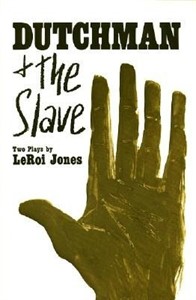
Dutchman is an emotionally charged and highly symbolic version of the Adam and Eve story, wherein a naive bourgeois black man is murdered by an insane and calculating white seductress, who is coldly preparing for her next victim as the curtain comes down. The emotionally taut, intellectual verbal fencing between Clay (the black Adam) and Lula (a white Eve) spirals irrevocably to the symbolic act of violence that will apparently repeat itself over and over again. Jones/Baraka's play is one of mythical proportions, a ritual drama that has a sociological purpose: to galvanize his audience into revolutionary action.
-
-
-
contains monologue for young African American man
-
-
1964, Cherry Lane Theatre, New York City
1971
Harper Perennial
9780688210847
Published in tandem with 'The Slave' through Concord Theatricals.

Stylized
Set in a time-bending, darkly comic world between heaven and hell, THE LAST DAYS OF JUDAS ISCARIOT reexamines the plight and fate of the New Testament’s most infamous and unexplained sinner.

Realistic
Angel Cruz is a thirty-year-old bike messenger from NYC who has lost his best friend to a religious cult. At the opening of the play, he is in his second night of incarceration, awaiting trial for shooting the leader of that cult in the “ass.” He is on his knees, alone and terrified, trying to say a prayer he no longer remembers to a God he has all but forgotten. Angel’s public defender is Mary Jane Hanrahan, still relatively young but very nearly disillusioned. At their first meeting, she mistakes Angel for another case. Wounded by her pride and Angel’s sharp attacks, she mangles this initial interview and walks out. A crisis of conscience and an unresolved connection to her childhood brings her back, and Angel’s heartfelt, persuasive arguments against the cult leader persuade her to champion his cause. By this time, the cult leader, Reverend Kim, has died on the operating table, and the charge against Angel is now murder. Angel has been beaten regularly by other inmates and is discovered in his cell barely conscious with a bed sheet tied around his neck. He is transferred to a special twenty-three-hour lockdown wing of protective custody. His jailer is Valdez, a brutally direct prison guard who believes in a world of black and white only. No gray areas permitted. Valdez has taken the post of Charlie D’Amico, a guard Angel never meets. For one hour a day, Angel experiences daylight from a cage on the Riker’s Island Prison roof. His only source of human contact is the lone inmate who is also in protective custody. Lucius Jenkins, a.k.a. “the Black Plague,” works out furiously in the cage next to Angel. A sociopathic serial killer awaiting extradition to Florida, Lucius pauses from his workouts only to chain smoke and to “save” Angel. Lucius Jenkins has found God, and Angel’s life and the course of his trial will be changed forever.